Question 1
You are asked to implement parts of a Naive Bayes classification algorithm from scratch, without using any libraries except numpy and math. Naive Bayes classification is based on Bayes’Theorem, predicting the probability that a set of data points belongs to one of several classes.
A full Naive Bayes classifier consists of four major steps:
- Calculate feature statistics by class
Compute the mean and variance of each feature inx_trainfor each class label iny_train. - Calculate prior probabilities
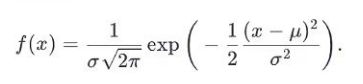
Calculate the proportion of training samples belonging to each class. - Implement the Gaussian Density Function The density function is:
f(x) = 1/(σ√(2π)) * exp(- (x - μ)² / (2σ²) )where μ is the mean and σ is the standard deviation of the feature.
- Calculate posterior probabilities and make predictions
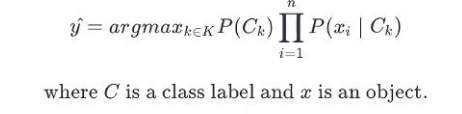
Using Bayes’Theorem:ŷ = argmax_k P(C_k) * Π f(xi | C_k)where C_k is a class label.
You are given:
x_train: 2D array of float valuesy_train: 1D array of class labelsx_test: 2D array of float values (same format as train data, without labels)
Your task is to implement only the missing sections under # implement this.
Input
x_train = [
[-2.6, 1.9, 2.0, 1.0],
[-2.8, 1.7, -1.2, 1.5],
[2.0, -0.9, 0.3, 2.3],
[-1.5, -0.1, -1.6, -1.1],
[-1.0, -0.6, -1.2, -0.7],
[-0.3, 1.2, 2.6, 0.2],
[-1.8, -1.3, -0.1, -1.2],
[0.2, 1.2, -0.6, -1.3],
[-5.2, 3.0, 0.2, 2.2],
[-0.8, -0.1, 1.5, -0.1],
[-2.3, 3.0, 0.8, 0.7],
[0.2, 3.0, 3.6, -0.9],
[1.7, -0.8, -0.0, 2.0],
[2.8, 0.8, 1.8, -0.7]
]

y_train = [1, 2, 0, 0, 0, 1, 0, 1, 2, 0, 2, 1, 0, 2]

x_test = [
[-0.1, 1.4, 0.4, -1.0],
[-1.3, 0.2, -1.3, -0.8],
[-1.1, 1.5, -2.3, -2.5]
]
Output
solution(x_train, y_train, x_test) = [1, 0, 1]
Question 2
Implement the missing code, denoted by ellipses. You may not modify the pre-existing code.
Your task is to implement parts of the Bagging algorithm from scratch (i.e., without importing any external libraries besides those already imported). As a reminder, Bagging classification comprises three major steps:
- Bootstrap the train samples for each base classifier.
- Train each classifier based on its own bootstrapped samples.
- Assign class labels by a majority vote of the base classifiers.
To validate your implementation, you will use it for some classification tasks. Specifically, you will be given:
x_train: a two-dimensional array of float values, where each subarrayx_train[i]represents a unique case.y_train: a one-dimensional array where each element is the true class label of the correspondingx_train[i].x_test: test data in the same format as the training data but without labels.n_estimators: the number of base classifiers.
Your model should fit the training data, then classify each sample in x_test, and return the predicted class labels.
Notes
- All training/test data will be float values.
- Do not modify any pre-existing code—only fill in the
# implement thisparts. - In a tie, choose the class label with the smaller number.
- Bootstrapping rules:
- Generate indices using
randint(0, n)wherenis the number of training samples. - Indices may repeat by nature of bootstrapping.
seedis used only initially.
- Generate indices using
Question 3
You are given a string expr representing a sum of two positive integers. Both integers do not contain zeros in their decimal representation. For example, expr can contain "741+12" — but it cannot be equal to "74112" or "740+12".
You must add exactly one pair of parentheses to expr so that:
- The plus sign
'+'is inside the parentheses. - There is at least one digit before the plus sign and at least one digit after it.
For example:"741+12" may be transformed into:
"7(41+1)2""74(1+12)"
But it cannot be turned into:
"(74)1+12""74(1)+12"
The resulting string must still represent a valid arithmetic expression.
You must compute the minimum possible value obtained after placing the parentheses.
Example:
For expr = "112+422",
all possible evaluated cases include:
(112+422) = 534
(11(2+4)22) = 308
(112+4)22 = 2552
1(12+422) = 434
1(12+4)22 = 108  ← smallest
...
The output should be:
solution(expr) = 108
VOprep 团队长期陪同学员实战各类大厂 OA 与 VO,包括 Coinbase、Google、Amazon、Citadel、SIG 等,提供实时答案助攻、远程陪练与面试节奏提醒,帮助大家在关键时刻不卡壳。
如果你也在准备公司,可以了解一下我们的定制助攻方案——从编程面到系统设计,全程护航上岸。